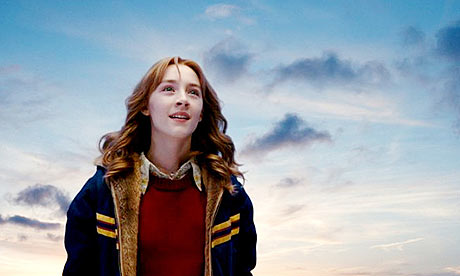
AN EDUCATION: http://www.youtube.com/watchv=kcDiHaLak1Q&feature=related
NOWHERE BOY: http://www.youtube.com/watch?v=EvL3pwdjy4k&feature=related
 I have chosen to textually analyse the two films ‘Nowhere Boy’ and ‘An education’. The two films are under the genre heading of ‘drama’. The genre drama is a genre where more naturalistic states are conveyed, often the story line is incredibly believable. The characters appear to go on a sort of journey, tackling different obstacles in their way. Often these obstacles are that, that one my find in their day to day life. This draws audiences in because it gives them something to relate to.
The opening of the scene that I have chosen in ‘an education’ starts with Jenny Millar a sixteen year old school girl listening to music. The music is non-diagetic meaning that the characters within the film are able to hear it. This contrasts with ‘nowhere boy’ where the music is diagetic. In both films its immediately clear the ages of he two main characters because they are both wearing school uniform. In the first few seconds of both films its clear that there’s a sense of wanting to escape ever so slightly. In ‘nowhere boy’ the teenage boy john is running from something, a clear sign of wanting to escape, then is awoken from a dream abruptly by a parent figure. The fact that he has been woken up by a parent figure also shows his age. Similarly in ‘an education’ Jenny is trying to escape the world she lives in by listening to French music, she is rudely awoken from her day dream and the little world she has undoubtedly created inside her head, by her father, again her father is telling her to do school work, another indication of age, like in ‘nowhere boy’. Both of the characters are denied their attempt at escapism by their elders.
 Its clear in the next scene that the two films set fairly similarly in time, give or take perhaps ten years. Both of the characters settle down to a meal. In ‘nowhere boy’ the room they’re sitting in really shows the time in which it was set. The room resembles what you may find in your grandma’s house, dun coloured walls, patterned plates, candles on the mantle piece. This indicates that John’s guardians are fairly old fashioned and that they might have more old fashioned views. This continues the theme of escapism, as a young boy its clear that John wont feel totally comfortable with the surroundings that he’s in. In ‘an education’ the room that they eat their meal in is extremely similar, once again dull coloured walls ornaments lacking in personality. In both cases I think this shows that the elder residents really care about what other people think, everything has to be by the book, it displays that sort of ‘what will the neighbours think’ viewpoint that people had during that era.
 As we’re introduced to the parent guardian characters, its clear that there a similar relationship displayed in both films. In ‘nowhere boy’ the older male, who we find out to be John’s uncle has a much more at ease relationship with his nephew. We find out that the two characters share the same interests- music. This is shown by the uncle handing over a harmonica. Its clear just by this act that those two characters are much closer. When his Aunt walks in there’s a sense of awkwardness, she appears to be believe in far more traditional roles. This is shown by the fact that her hair is up, and she brings the plates of food in, showing that she has been doing the cooking. Therefore demonstrating traditional roles of men and woman during that time. In ‘an education’ parent relationships are also established. Jennys father appears to be more dominant, asking all the questions almost being slightly aggressive, he seems to be the traditional protective father. Jenny’s mother however seems to have submitted herself to this sort of behavior I’m sure she has become acclimatised to it. She seems to want to reveal her individuality a little bit though. This is shown by the clothes she is wearing. In the dinner scene she’s wearing a bright orange, flowery top. This perhaps shows she’s letting her more creative side through. This could also display a sign of the change in eras, also once again perhaps the theme of escapism and wanting to express herself a little bit more. Not only the way in which she dresses shows that there appears to be a change socially in time, the fact that Jennys father talks a lot about Jenny going to university and therefore presumably having a career. It seems that Jennys mother would have most likely been a house wife, and that Jenny, being a girl and having prospects is something that would have only really starting occurring around Jennys generation.
 Although both John in ‘nowhere boy’ and Jenny in ‘an education’ are around 16-18 they’re parents or guardians appear to still be protective and almost attempt to wrap them in cotton wool. Once again shows the era, as now a-days we have a far more permissive society and we lose our attachment to parents a lot earlier on. In ‘an education’ we see that Jenny has received some flowers from a male admirer. Both of her parents look over her shoulder trying to ascertain who they are from. Her father has a very negative view about the whole situation, he talks about Jenny being to young to receive such an expensive array of flowers. Once again he addresses this situation in a far more aggressive way, however audiences are aware that he’s just concerned for his daughter. Her mother seems far less worried, she seems to think that it’s a very nice gesture. This shows that Jennys mother is her ally. Similarly in ‘nowhere boy’ as John leaves the house, his aunt shouts out of the window ‘Don’t forget you’re glasses John’. This shows she still has a parental hold over her nephew, even though she knows he’s old enough to look after himself she still wants to mother him. Like Jenny’s father she doesn’t really want him to grow up. Also we have established that Johns uncle is his ally, like Jennys mother is hers. This also creates a kind of gender stereotype. As Johns ally is his uncle, a male of course, and Jenny ally is her mother, a female. This shows how men are different to woman, and also perhaps the fact society at the time is just beginning to come out of a time where men and woman have specific roles.
 In the next scene the two characters are seen with their friends. In ‘nowhere boy’ there’s diagetic music playing, Jerry Lee Lewis ‘Wild one’. This reinforces the character of John being a ‘wild one’ and the time. The song is from the era the film is set and is a rock and roll song, which foreshadows Johns later interest in that genre of music. We see John with a friend on a bike, for a few moments he takes his hands of the handlebars. This shows that away from his family home, he is finally allowed to escape. He shrieks and shouts, which shows that he’s expressing himself. This also shows that he has to be far more conservative at home. This also displays his rebellious nature, as a teenager when youre told something isn’t acceptable you’re far more likely to do it. So by him freewheeling through the park with his friends it shows him rebelling ever so slightly to society and his guardians. In ‘An education’ Jenny and her friends are sitting in a café, Jenny is smoking. This not only shows the era, but also shows that she is slightly more mature for her age, which contrasts with John in ‘nowhere boy’ who was acting immaturely with his friend. Jenny is discussing literature which reinforces her intelligence, something that her father was almost boasting about earlier. Her way of escaping is through reading and getting absolutely swept up in the story world. Jenny then goes on to talk about after going to university she is going to ‘become French, going to live in Paris and going to smoke and wear black..’ Once again day dreaming to escape the life she lives at the moment. We have established that she has an extremely tradition family, she wants to escape from this and explore and lead an interesting life, different from her parents. This again shows how the times have changed. Previously is society young woman would have done as their mothers did, worn what their mothers would have worn and prepared for a life at home, like their mothers. Jenny doesn’t want this. She’s rebelling against society, however not in so much of a disruptive way like John. The talk of Jenny wearing black, going to Paris and smoking etc foreshadows how her life will be later on in the film.
 Although the two characters have shown that they are able to escape ever so slightly. We are reminded again by how old they actually are. In ‘an education’ Jenny bumps into her admirer, she goes over to talk to him. Its clear that she is nervous and doesn’t really know how to respond to anything he is saying to her. He offers to take her to a concert then to supper. Its clear that Jenny seems extremely belittled by this experience, the fact that she has to consult her parents and has never been to supper before. We can tell she is nervous and slightly out of her depth because of how she hesitates and sounds unsure about everything her admirer is saying. When she then consults her father, she is quickly brought down to earth, with him saying no to her. By her father saying no, we are quickly reminded of her age and how her elders have the power to take her dream away. In ‘Nowhere boy’ John decides to flash to one of his piers. Another sign of expressing himself, he gets taken to the head teacher. His freedom is quickly taken away by an elder, which is also what happened in ‘an education’ with Jennys father not allowing her to go to the concert. Johns head teacher talks about him going ‘nowhere’ and john responds with ‘are there genius’ in nowhere’? This is ironic of course because Johns head teacher doesn’t believe that he has any prospects and that he’s not going anywhere, however of course this sets us up for what later happens in the film with John become a musical genius. This contrasts with Jenny, her father tells her that she is a genius however the journey she’s about to embark on, leaves her with nearly ruining her prospects.
The two films at first glance are about two completely separate things. However delving deeper its clear that they’re far more similar than first thought. It also displays how within the same genre there are themes that are reoccurring and you cant really escape them. To be successful you just have to recreate these themes in very different ways.


 I would very much say that my favourite genre is the drama genre. The genre is one that is very easy to get your head around. In the genre of drama it appears that there is a fairly simple narrative structure. There is the story (what happens to different characters, he discourse, how the story unfolds). It seems that conflict is often what makes a drama, this is to be expected as the the usual purpose of a dramatic story line is to move the audience in an emotional way. Often, dramas are incredibly naturalistic which draws the audience further in. Generally there is some sort of struggle going on, could be personal, political or even national.
  Dramas are usually serious stories, in which the characters may go on some sort of emotional journey but depicting real life situations, rather than Hollywood-ised fantasies.